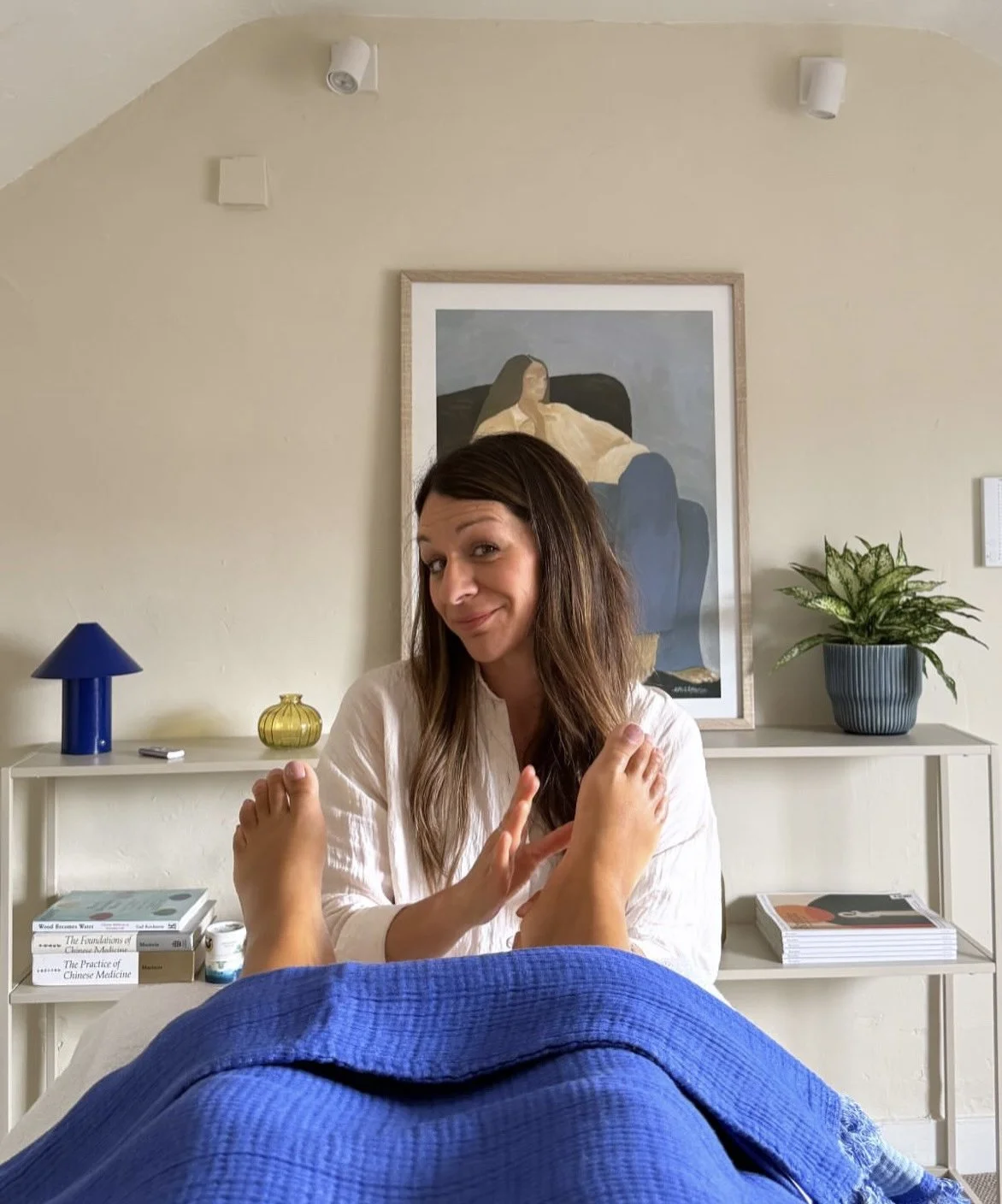
Why Hypermobile and Neurodivergent Women Often Respond So Well to Reflexology

I want to be upfront before I start: this is a clinical observation, not a clinical claim. It's something I noticed gradually across five years of treating women - a pattern that kept showing up whether I was looking for it or not. The research is now starting to catch up with it, which is satisfying. But I noticed it first through paying attention, not through study.
Which, honestly, is pretty on brand for me. Quietly noticing patterns and sitting with them for a long time before saying anything out loud -that's a very autistic way of working. And it's probably why I spotted this at all (I suspect i’m AuDHD and i’m also perimenopausal)
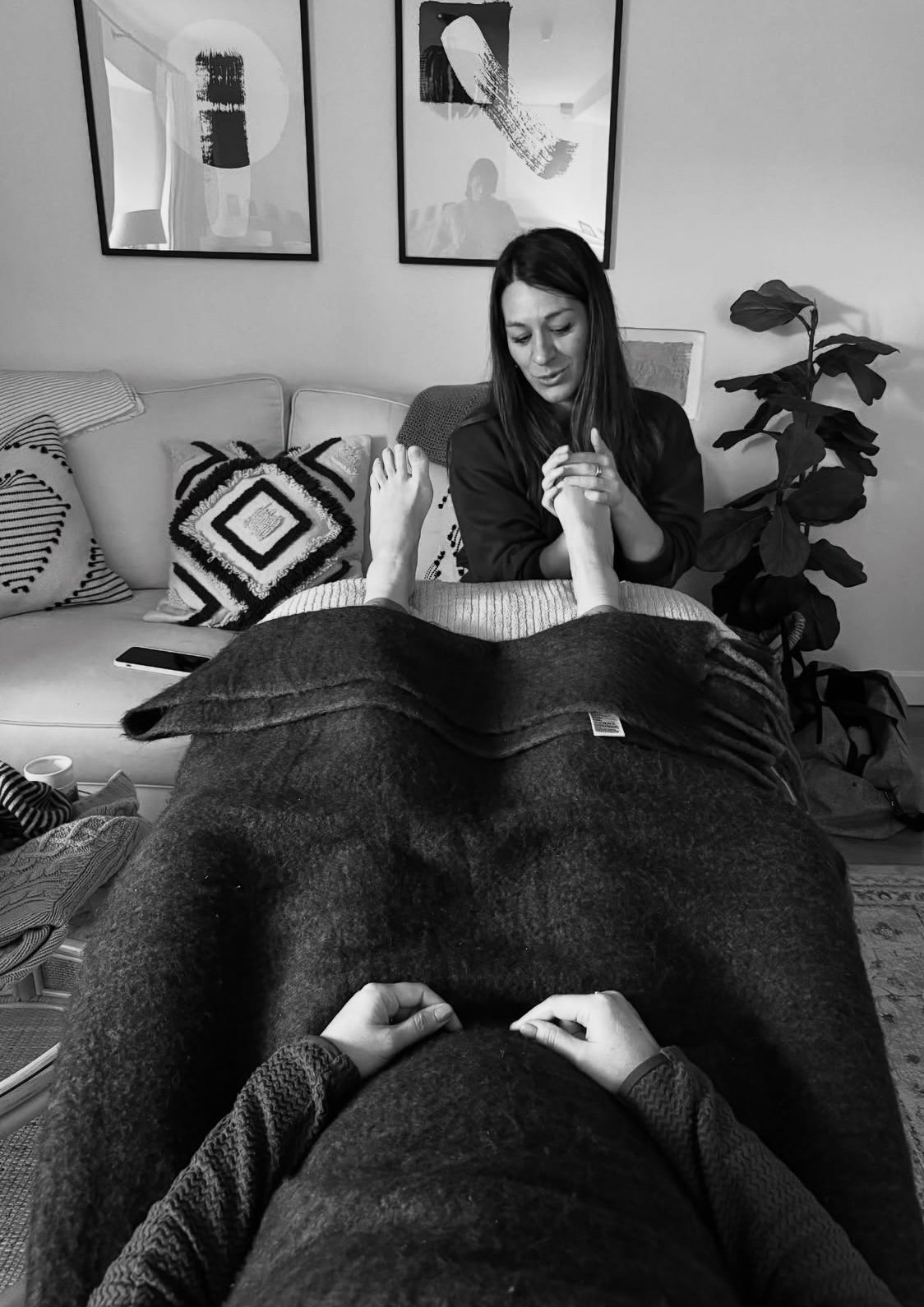
What I kept noticing in clinic.
It wasn't one session or one client. It crept up on me slowly over lots of sessions.
Certain clients feel different the moment I start working with their feet. Their skin is unusually soft — almost velvety. Their toes and ankles move in ways that are wider than you'd normally expect. And even when they're comfortable and willing to relax, there's this subtle resistance — their feet stiffen slightly, pull back just a little, as if the body isn't quite ready to let go yet. Not because anything is wrong. Just because that's how their nervous system is wired.
Their adrenal reflexes are almost always busy — congested and reactive in a way that tells me their stress response has been running on high alert for a very long time. Not from one difficult week. From years of it.
And when I started paying attention to who these clients were, I kept seeing the same things: hypermobility. Neurodivergence - either diagnosed or suspected. And very often, perimenopause.
Too many times to be a coincidence.
What the research is starting to show.
I'm not the only one who's noticed this connection. Researchers at Brighton and Sussex Medical School have been doing really interesting work in this space — particularly Dr Jessica Eccles, who has led studies looking specifically at the overlap between hypermobility and neurodivergence.
Her team found that over half of adults diagnosed with autism, ADHD or Tourette syndrome showed elevated levels of joint hypermobility — compared with around 20% of the general population. A separate review published in 2025, looking at more than 20 studies, found that nearly four in ten autistic people meet the criteria for Ehlers-Danlos Syndrome or Hypermobility Spectrum Disorder. These are big numbers.
The reason this connection exists isn't fully understood yet — scientists are still working it out. But the current thinking points to connective tissue. Hypermobile people have a difference in their collagen and fascia — the tissue that runs throughout the body, not just around joints but around organs, the gut lining, and the nervous system itself. When that tissue is more elastic and less structured than typical, the nervous system it supports tends to be more sensitive and harder to regulate. More reactive to the world. Quicker to reach overwhelm.
Which maps pretty exactly onto what I see on my treatment bed.
Why perimenopause tends to bring it all to the surface.
This is the bit that really clicked for me.
A lot of neurodivergent women - especially autistic women and those with ADHD - have spent their whole lives masking. Since puberty, they've worked out how to suppress their natural responses, mirror what everyone else is doing and present a version of themselves that fits more neatly into the world around them. It's exhausting. And for many years, the hormonal environment of their reproductive years provides a kind of scaffolding that makes it possible to keep doing it.
Then perimenopause arrives. Oestrogen - which plays a real role in regulating the nervous system - starts to fluctuate. And slowly, the structure that's held everything together starts to feel harder to maintain. The overwhelm increases. Sensory sensitivities sharpen. Emotional regulation wobbles. Brain fog rolls in. Procrastination gets worse. Things that were manageable for decades suddenly aren't.
This is why so many women are getting autism and ADHD diagnoses for the first time in their 40s. It's not that they've only just become neurodivergent. It's that perimenopause has quietly dismantled the coping strategies they didn't even realise they were using.
And for the ones who are also hypermobile - with a nervous system that was already running closer to its limit than most — perimenopause can feel particularly destabilising. Their bodies have been working very hard for a very long time. And it's starting to show.
Why reflexology tends to work so well for these women.
Reflexology works by activating the parasympathetic nervous system - the rest-and-digest response that counteracts fight-or-flight. For women whose nervous systems have been in a state of low-level alert for years, this isn't a nice treat. It's something their body has been trying to find for a very long time.
The sensitivity that makes life feel so loud and so much for hypermobile and neurodivergent women also makes them deeply responsive to reflexology. Because their nervous systems are so finely tuned, the signals travel quickly. Where someone else might feel pleasantly relaxed, these women often experience something more significant - a proper unwinding that some of them describe as feeling, for the first time in years, genuinely safe in their own body.
The resistance I feel in their feet at the start - that subtle stiffening, the difficulty fully letting go - is useful information. It tells me exactly what we're working with. And across a course of sessions I watch it change. The feet become easier to hold. The adrenal reflexes quieten. The client starts arriving already a little softer, because their system has started to learn that this is a place it can regulate.
It takes time. Which is why I always recommend six weekly sessions for these clients rather than a one-off. But when it works - and it usually does - it's one of the most rewarding things I do.
What I say when I notice this with a client.
I want to be clear: I'm not diagnosing anyone. That's not my job and it's not what I'm trying to do.
What I do is share what I'm noticing — gently, and without any agenda around what they do with it. Something like: I'm noticing your feet are unusually flexible and your adrenal reflexes are very active. Have you ever been told you're hypermobile? Do you ever feel like your nervous system is just... louder than other people's?
The response I get, almost every time, is a kind of relieved exhale. Not because they've been given a label - I'm very deliberate about saying this isn't about labelling - but because someone has finally noticed something real about how their body and brain work. Something that explains a lot. Something that isn't a character flaw or a lack of resilience or not trying hard enough.
Just: your nervous system works differently. And that makes complete sense of everything you've been telling me.
That moment - of being seen, properly, maybe for the first time by a practitioner - tends to be the turning point in the therapeutic relationship. And it's the reason these clients often become my most committed long-term regulars.
A quick caveat before you go.
The research in this area is still developing. Dr Eccles and her team are continuing their work and we don't yet have a full picture of why hypermobility and neurodivergence overlap so consistently, or all the ways that overlap shows up in the body. I'm not a doctor and I'm not offering medical treatment for any of these conditions.
What I am offering is a therapy that supports nervous system regulation - one that seems, in my experience, to be particularly well-suited to people whose nervous systems are wired this way. I share my observations with clients as just that: observations, offered without pressure, to be taken or left as feels right for them.
If you've read this far and recognised yourself, you might not be looking for more theory - you might just want somewhere that already gets it. I've built a calm, low-demand reflexology space for neurodivergent and hypermobile women, here in Cheltenham and the Cotswolds. No diagnosis needed.