Why You Can't Think Your Way Out of Stress - And What to Do Instead
If you've ever lain awake at 2am telling yourself to calm down and found that it doesn't work — this post is for you.
Not because you're doing something wrong. But because you're trying to solve a body problem with a brain tool. And those two things don't work in the direction you might think.

Two ways to regulate (and why most of us are using the harder one)
There are generally two approaches to nervous system regulation and they move in opposite directions.
The first is top-down. This is what most of us default to: using the thinking brain to try to manage how the body feels. Journalling, reframing, breathing exercises with a timer, talking it through with a therapist, telling yourself it's not that bad. All genuinely useful. All working from the mind downward, trying to persuade the body to settle.
The second is bottom-up. This starts with the body - with physical sensation, touch, movement, pressure and lets regulation travel upward. The body leads. The mind follows.
Here's the thing nobody tells you: when your nervous system is properly dysregulated, your prefrontal cortex (the part of the brain responsible for rational thought, perspective and calm reasoning) is often the first thing to go offline. Which means that at the exact moment you most need to think your way to calm, thinking is the least reliable tool you have.
This isn't a weakness. It's neurobiology. And once you understand it, a lot of things start to make sense - including why you can journal about stress for an hour and still feel it sitting in your chest.
Your feet are doing something extraordinary - or they would be, if you let them.
I want to talk about feet for a minute, because they get a bad rep and they deserve better.
Each foot contains over 200,000 nerve endings - more than almost any other part of the body relative to size. These aren't passive body parts. They're active sensory organs, designed to gather real-time info about the ground beneath you, feed it to the brain, and help your whole system orient, balance and adapt.
For most of human history, feet did exactly that. They moved over varied terrain, felt different textures and temperatures, sent a constant stream of rich sensory data upward through the nervous system. That connection between feet and brain kept neural pathways active and well-used.
Then we put them in shoes. Cushioned, rigid, narrow shoes that create a thick barrier between the soles of the feet and the world. And those nerve endings - which were never designed to be silent - went quiet.
Research into barefoot movement confirms what reflexologists have known for a long time: when the feet are deprived of sensory input, the neural pathways that depend on that input weaken. The principle is the same one that applies to muscles - use it or lose it. Except in this case what you're losing is a direct communication channel between your body and your brain that most people never knew they had.
What happens when you stimulate those nerve endings - deliberately.
This is where reflexology comes in - and why I think it's one of the most direct bottom-up tools available.
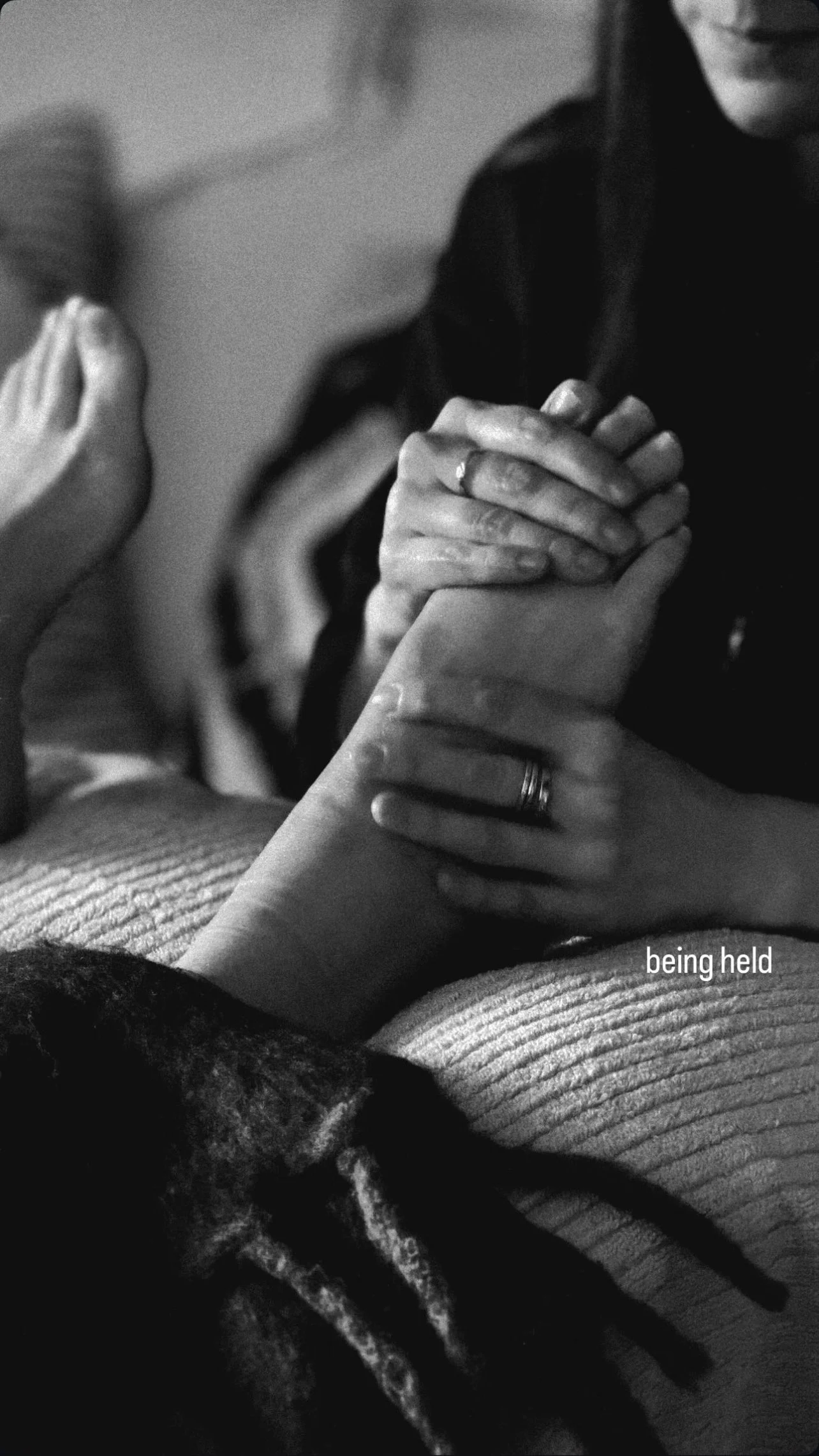
When I work on someone's feet in a session, I'm applying precise, deliberate pressure to specific reflex points that correspond to every organ, gland and system in the body. That stimulation wakes up nerve endings that have been quiet, sometimes for years. It sends signals upward through the nervous system along pathways that haven't been properly used since the client last went barefoot on a beach.
Those signals travel via the vagus nerve - the long, wandering nerve that runs from the brainstem all the way down through the heart, lungs and digestive system. The vagus nerve is the main highway of the parasympathetic nervous system, and it's one of the primary regulators of our stress response. Stimulate it from the bottom up - through the feet, through touch, through sensation — and you activate the rest-and-digest state that chronic stress has been suppressing.
The brain doesn't have to decide to relax. The body tells it to.
This is also why a lot of clients fall asleep during a reflexology session, even if they've been running on adrenaline for weeks. It's not the comfortable bed or the warm room. It's the nervous system finally receiving a signal it recognises - and responding accordingly.
Regulation has to be felt — not just understood.
Here's something that stopped me in my tracks when I first came across it.
A researcher called Joseph LeDoux spent years studying how we process emotions - and what he found was that most of it happens without us even knowing. By the time you're aware of feeling anxious, your nervous system has already been in that state for a while. The conscious mind is the last to know, not the first.
Which means that trying to think your way to calm is a bit like trying to steer a car from the back seat. You can see where you're going. You just can't reach the wheel.
This is why you can know, rationally, that everything is fine - and still feel it in your chest. Why you can talk through your stress for an hour and walk out of the conversation still carrying it. The understanding hasn't reached the part of the nervous system that's holding the tension. Because that part doesn't speak in thoughts. It speaks in sensation.
Dr Stephen Porges - whose work on the vagus nerve has influenced a lot of how we now understand stress - describes safety as something the body detects before the mind does. Not a conclusion you reason your way to, but a feeling that arrives through the senses. Warmth. Pressure. A slowing heartbeat. Touch.
Now, his theory has its critics in the scientific world - it's popular in clinical practice but contested by some researchers. But the broader idea it points to is something I see confirmed on my treatment chair every single week. The body isn't waiting for the mind to give it permission to relax. It just needs the right kind of input - and then it does it on its own.
Chrissy Silva performing reflexology at her Cheltenham clinic
We've known this since the very beginning of life.
Here's the part that always gets me.
The very first thing a newborn needs, before almost anything else is skin-to-skin contact. Not because it's comforting in a vague, emotional sense. Because it is neurologically necessary.
A systematic review of 22 studies found that skin-to-skin contact in the first hours and days of life directly regulates the infant's autonomic nervous system - stabilising heart rate, cortisol levels, breathing patterns and vagal tone. The touch of a caregiver's skin quite literally sets the baseline for how a new nervous system learns to function.
That need for skin-to-skin doesn't disappear when we grow up. We just stop honouring it.
We live in an era where we're more connected than ever and more touch-deprived than ever. We manage stress with apps and supplements and strategies, many of which are genuinely helpful. But they're working top-down, from the mind. And sometimes what the nervous system actually needs is the thing it needed first - to be held, touched, regulated through the body (it’s why i’m a big fan of hugs!)
Reflexology is not the same as being held as a newborn, obviously. But the mechanism is related. Skilled, intentional touch that activates the nervous system through sensory receptors in the skin - creating what researchers describe as felt safety rather than reasoned safety. The body recognises it before the mind does.
Okay, so what does this mean for you?
None of this is an argument against therapy, journalling, medication or any of the other top-down approaches that genuinely help people. It's an argument for combining them with something that works from the other direction.
If you've been doing the cognitive work - understanding your patterns, building your insight, reframing your thoughts - and you still feel it in your body, it might be time to meet that body where it is. Not by thinking harder, but by giving it the kind of input it was designed to receive.
Start from the ground up. Quite literally.
Your nervous system already knows what to do when it feels safe. The job is just to help it feel that way - and sometimes the most direct route there is through 200,000 nerve endings in the soles of your feet.
If this resonates and you're curious what a bottom-up approach to stress, hormones or nervous system regulation might look like for you specifically, I'd love to hear from you.
My clinics are in Montpellier, Cheltenham and Bourton-on-the-Water in the Cotswolds - or find out more about The Foundation Series.