What Happens in Vagus, Stays in Vagus.
Ever caught yourself saying any of these?
"I'm sick to my stomach with worry."
"I've got butterflies in my belly."
"I'm absolutely bricking it."
There's a reason your body keeps reaching for gut metaphors when stress shows up. It's called the vagus nerve — and once you understand what it actually does, a lot of what feels random or "all in your head" suddenly starts making sense.
Especially if you're in your 40s and your nervous system has started behaving like a stranger.
The vagabond nerve.
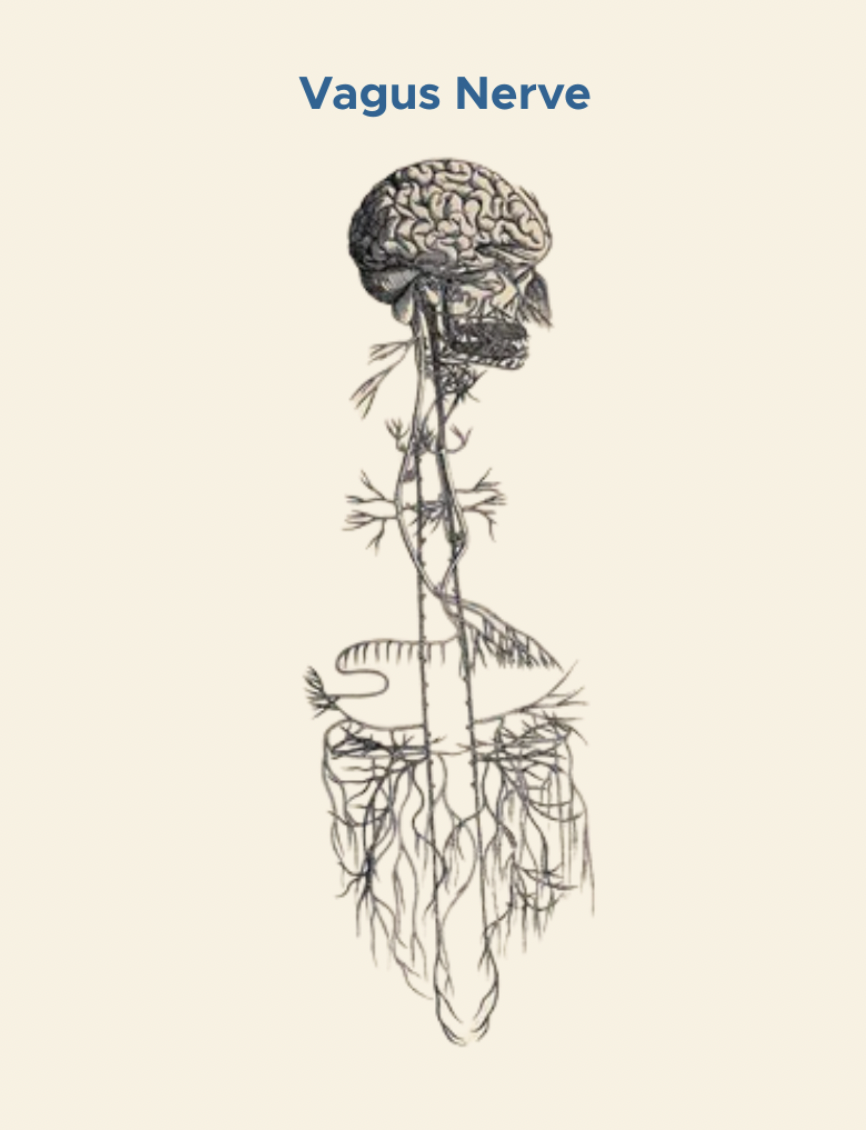
The vagus nerve is your body's longest cranial nerve. Vagus is Latin for "wandering" - and it lives up to the name. It starts at the base of your skull, travels down each side of your neck, through your chest, and fans out across your gut. Along the way it touches your heart, lungs, throat, voice and digestion.
Think of it as a very sensitive inner alarm network. Its job is to read the room - am I safe? am I in danger? - and switch your body into the right gear accordingly.
When the vagus is working well, you can move smoothly between fight or flight (when you genuinely need to act) and rest and digest (when it's safe to recover). When it isn't, you get stuck.
What happens when the vagus glitches.
Here's the thing about modern life - those tiny everyday stresses aren't big enough on their own to feel like emergencies. The inbox at 11pm. The school WhatsApp group. The parent who can't remember your name anymore. The news. The ageing dog. The noise. So we shrug them off.
But the vagus nerve doesn't shrug them off. It registers each one as a small alarm bell.
🔔 Email after hours.
🔔 Argument before breakfast.
🔔 Three weeks of broken sleep.
🔔 A diary that hasn't had white space in two months.
Stack enough of these and the body stops being able to tell the difference between actual danger and a Tuesday. The vagus nerve gets stuck in a glitch - defaulting to alert mode, forgetting how to drop you back into safe mode, even when nothing's actually wrong.
This is what poor vagal tone feels like. And it shows up as:
✔︎ IBS, bloating and digestive chaos
✔︎ Constant sighing, random palpitations & anxiety
✔︎ Stubborn fat storage around the middle
✔︎ Hormone imbalances that bloodwork won't explain
✔︎ Sleep that won't settle no matter how tired you are
✔︎ Hypervigilance - flinching at small things, snapping easily
✔︎ Burnout that doesn't lift even on holiday
If you're nodding right now, you're not imagining it. And you're not broken. Your nervous system is just stuck in low-grade danger mode.
Why this hits harder in your 40s.
This is the bit nobody talks about, and it's a hill I will die on:
Perimenopause is a hormonal shift - but what it does to your nervous system is where most women's symptoms actually live. And that's the part nobody's addressing.
Estrogen is one of the things that helps keep your vagal tone stable. So when it starts fluctuating (sometimes wildly) in your late 30s and 40s, the nervous system loses one of its key stabilisers. The glitch gets stickier. The alarm bells start ringing at things that wouldn't have bothered you a year ago.
That's why women in perimenopause so often describe:
Anxiety they've never had before, appearing out of nowhere
Palpitations at 3am that bring them upright in bed
IBS-type symptoms turning up in their 40s for the first time
Sleep that breaks at 3am and won't come back
Suddenly feeling unsafe doing things they used to find easy - driving at night, public speaking, being alone in the house
These aren't separate symptoms. They're the same symptom in different costumes: a nervous system that's lost its baseline.
You haven't changed. Your hormones have. And your nervous system is asking for support.
A note for hypermobile and neurodivergent women.
If you're hypermobile, autistic, ADHD, or some combination of the three, your nervous system was probably already running closer to the edge before perimenopause turned up. These populations tend to have lower vagal tone and more sensitive nervous systems to begin with - which is why perimenopause can feel like the wheels have come off, fast.
In my clinic this will look like women experiencing sensory aversion to certain textures, smells, rage from the sound of anyone breathing to hating crowds and noisy environments. Increased pain and allergy flares thanks to hormones influencing histamine and mast cells. I see them respond so well to reflexology because their systems are so finely tuned to input and stimulus.
This isn't a flaw. It's information. And it changes how we approach your treatment.
Two facts about your gut that will surprise you.
Before we get to what actually helps, two pieces of trivia that change how you'll think about all of this:
Around 90% of your body's serotonin lives in your gut, not your brain. Which is why "I've got a gut feeling" turns out to be more literal than poetic.
About 80% of vagus nerve signals travel from your gut up to your brain - not the other way around. So when your gut is unhappy, it's not quietly suffering. It's sending an enormous amount of information north, and your brain is listening whether you like it or not.
Traditional Chinese Medicine has called the gut the second brain for centuries. The Western science is just catching up.
What the wellness world is finally figuring out.
For the last decade, wellness culture has been obsessed with measurement. Sleep scores. HRV graphs. Continuous glucose monitors on people who don't have diabetes. Cold plunges before dawn. The promise was that if you just tracked enough variables, you could optimise your way to feeling well.
In 2026, the Global Wellness Summit named the Over-Optimization Backlash the defining trend of the year. There's now a clinical condition called orthosomnia — sleep anxiety caused by sleep-tracker feedback — entering mainstream medical literature. People are quietly realising that wellness was meant to feel good, not become another thing to be bad at.
Reflexologists have been saying this all along: you don't fix a glitchy nervous system by measuring it harder. You fix it by giving it the conditions to feel safe.
The nervous system, it turns out, is the new six-pack. Welcome.
How to unstick the glitch.
The good news is that vagal tone is highly trainable. You can't think your way out of a stuck nervous system — but you can absolutely work with the body to reset it. Here's what genuinely helps:
Cold exposure (the gentle kind). You don't need an ice bath. Splashing cold water on your face and neck, or finishing your shower with 30 seconds of cold, stimulates the vagus nerve directly. For women already running hot on cortisol, the gentle version is plenty - full cold plunges can be too triggering.
Diaphragmatic breathing. Slow, deep breaths from the ribs and belly, not the chest. Longer exhale than inhale. Five minutes a day will do more for your vagal tone than most things you can buy.
Yin yoga. The slow, held kind. Not the sweaty kind. The point is down-regulation, not a workout.
Singing, humming and gargling. Sounds ridiculous but the vibration is the active ingredient - the vagus nerve runs through your throat. Hum in the shower. Gargle aggressively when you brush your teeth. Sing badly in the car. All of it counts.
Co-regulation. This is the one nobody tells you about. Your nervous system isn't just regulated by what you do — it's regulated by who you spend time around. Sitting with a calm person whose nervous system is settled will pull yours toward settled too. Which is, biologically, exactly what a reflexology session is.
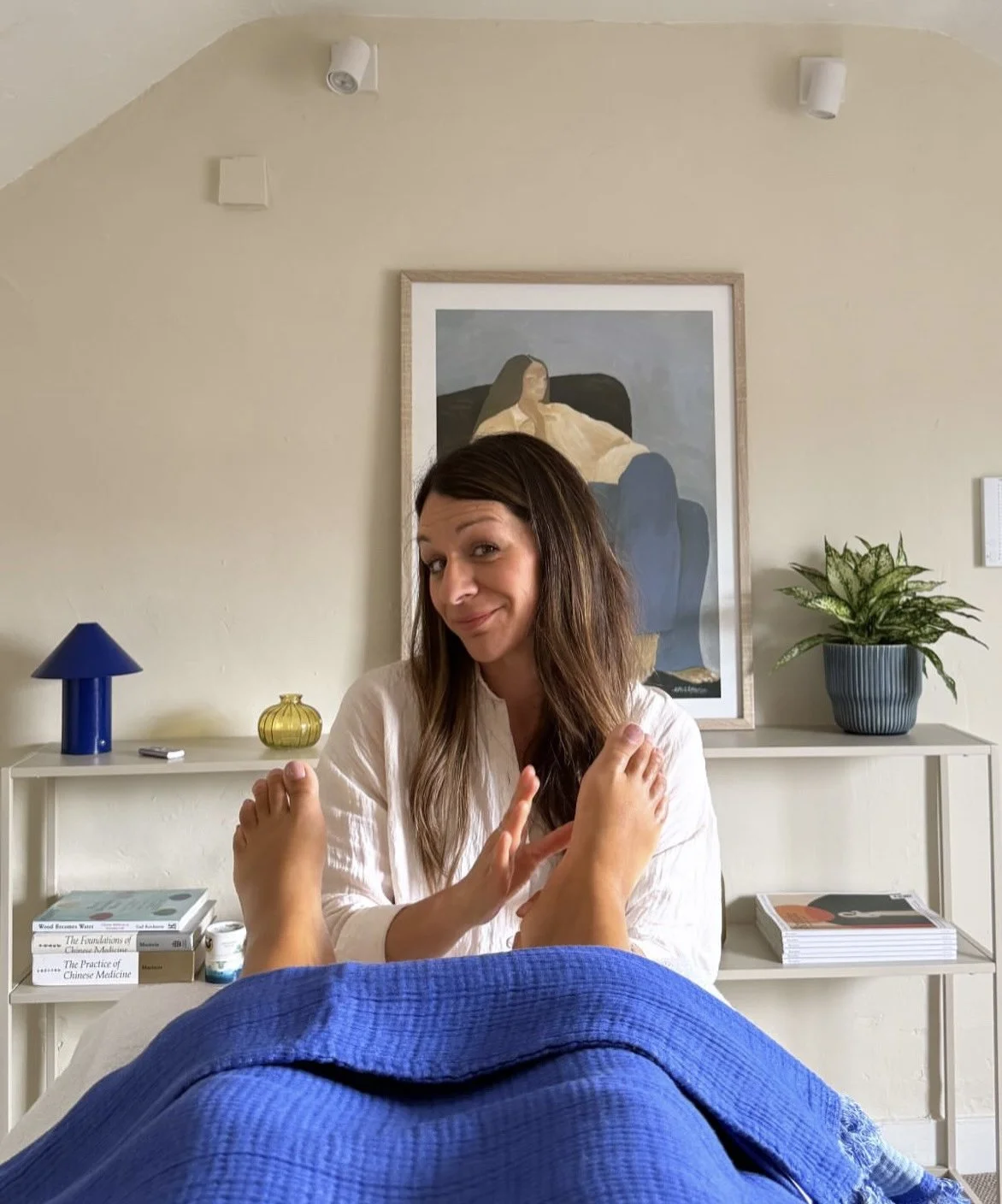
Reflexology with a practitioner who knows your nervous system. Reflexology works on thousands of nerve endings in the feet, many of which connect directly into the parasympathetic system. It doesn't force the body into safety - it gives it permission. There's a difference, and your body knows it.
The line worth keeping.
Here's the bit I want you to take with you, even if you remember nothing else:
No amount of healthy eating, exercise or even therapy will work as effectively if your nervous system is stuck in danger mode.
You can't out-supplement a glitchy vagus nerve. You can't out-discipline it. You can't out-think it. The nervous system has to come first, because everything else builds on top of it.
Once your body feels safe, homeostasis - the body's natural state of balance - does most of the work for you.
Where to start
If any of this has sounded uncomfortably familiar, you're in the right place.
The Foundation Series for Hormones & Perimenopause is six weekly reflexology sessions designed for exactly this - for women whose nervous systems have been running on alert for too long and need consistent, focused support to find their way back to settled. £500, paid in advance, available at both the Cheltenham and Bourton-on-the-Water clinics.
Or if you're not quite ready for that yet:You can book a single first session then there’s a monthly membership option should that feel best.
Your vagus nerve has been asking for your attention. This is what listening looks like.
PS: Not local to Cheltenham? Sign up to The Off Switch - 5 days of free DIY foot reflexology recordings you can do yourself at home.
Chrissy Silva is a specialist reflexologist based in Montpellier, Cheltenham and Bourton-on-the-Water. She works with women in their 40s navigating stress, hormones and perimenopause - using reflexology to support the nervous system back into balance.